




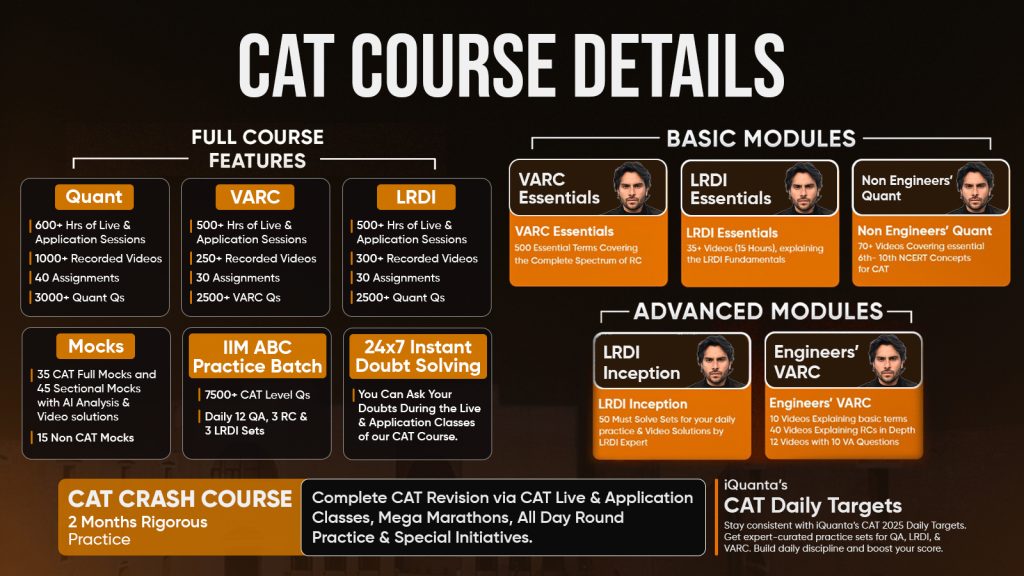
If you are planning to appear for CAT and target top IIMs, understanding the complete CAT course details is essential. From syllabus and exam pattern to eligibility and preparation strategy, having clarity helps you choose the right preparation plan and avoid confusion later.
Whether you are a beginner or a working professional, structured preparation plays a major role in achieving a high percentile. Many aspirants today prefer guided online programs like those offered by iQuanta, known for its strategic and mentorship-driven CAT preparation.
What is CAT?
The Common Admission Test (CAT) is a national-level MBA entrance exam conducted for admission into prestigious management institutes including the Indian Institutes of Management (IIMs) and other top B-schools in India.
The exam evaluates:
- Quantitative aptitude
- Logical reasoning and data interpretation
- Verbal ability and reading comprehension
A well-structured CAT course prepares you for all these sections systematically.
CAT Eligibility Criteria
Before enrolling in a CAT course, ensure you meet the basic eligibility requirements:
- A bachelor’s degree from a recognized university
- Minimum 50% marks (45% for reserved categories)
- Final-year graduation students are also eligible
There is no age limit to apply for CAT.
CAT Exam Pattern Overview
The CAT exam is divided into three major sections:
1. VARC (Verbal Ability and Reading Comprehension)
- Reading comprehension passages
- Para jumbles
- Summary-based questions
2. DILR (Data Interpretation and Logical Reasoning)
- Caselets and charts
- Logical puzzles
- Seating arrangements
3. QA (Quantitative Aptitude)
- Arithmetic
- Algebra
- Geometry
- Number system
- Modern mathematics
The exam is time-bound with sectional limits, making strategy and time management extremely important.
CAT Syllabus in Detail
While CAT does not officially release a fixed syllabus, preparation broadly covers:
- Arithmetic topics such as percentages, profit and loss, time and work
- Algebra including equations and inequalities
- Geometry and mensuration
- Logical reasoning sets and DI charts
- Reading comprehension from diverse topics
A good CAT course ensures complete topic coverage along with practice and revision.
CAT Course Duration
The ideal preparation duration depends on your current level:
- Beginners: 8–12 months
- Intermediate level: 6–8 months
- Repeat aspirants: 4–6 months
Starting early allows enough time for concept building and mock practice.
CAT Course Fees
CAT course fees vary based on:
- Online or offline mode
- Live classes or recorded lectures
- Mentorship and doubt-solving support
- Access to mock test series
Online courses are generally more flexible and affordable. Platforms like iQuanta provide structured online programs that combine live sessions, mock tests, and performance analytics.
What Should a Good CAT Course Include?
When choosing a CAT course, look for:
- Complete syllabus coverage
- Regular live classes
- Topic-wise practice material
- Sectional and full-length mock tests
- Detailed performance analysis
- Strategy and revision sessions
iQuanta focuses on concept clarity, shortcut techniques, and performance tracking to help students aim for 95+ and 99+ percentiles.
Preparation Roadmap for Top IIM Admission
To maximize your CAT performance:
- Strengthen fundamentals in the first phase
- Practice daily topic-wise questions
- Begin sectional tests early
- Attempt full-length mocks regularly
- Analyze every mock thoroughly
- Revise weak areas consistently
Consistency and strategic improvement are the keys to cracking CAT.
Final Thoughts
This Complete CAT Course Details Guide gives you clarity on syllabus, eligibility, exam pattern, duration, and fees. Choosing the right course and following a disciplined preparation plan significantly increases your chances of securing admission to top IIMs.
With structured guidance and expert mentorship from iQuanta, you can prepare smartly and confidently for CAT.
Comments