


- Abuse & The Abuser
- Achievement
- Activity, Fitness & Sport
- Aging & Maturity
- Altruism & Kindness
- Atrocities, Racism & Inequality
- Challenges & Pitfalls
- Choices & Decisions
- Communication Skills
- Crime & Punishment
- Dangerous Situations
- Dealing with Addictions
- Debatable Issues & Moral Questions
- Determination & Achievement
- Diet & Nutrition
- Employment & Career
- Ethical dilemmas
- Experience & Adventure
- Faith, Something to Believe in
- Fears & Phobias
- Friends & Acquaintances
- Habits. Good & Bad
- Honour & Respect
- Human Nature
- Image & Uniqueness
- Immediate Family Relations
- Influence & Negotiation
- Interdependence & Independence
- Life's Big Questions
- Love, Dating & Marriage
- Manners & Etiquette
- Money & Finances
- Moods & Emotions
- Other Beneficial Approaches
- Other Relationships
- Overall health
- Passions & Strengths
- Peace & Forgiveness
- Personal Change
- Personal Development
- Politics & Governance
- Positive & Negative Attitudes
- Rights & Freedom
- Self Harm & Self Sabotage
- Sexual Preferences
- Sexual Relations
- Sins
- Thanks & Gratitude
- The Legacy We Leave
- The Search for Happiness
- Time. Past, present & Future
- Today's World, Projecting Tomorrow
- Truth & Character
- Unattractive Qualities
- Wisdom & Knowledge




FOLLOWERS
0
Users
Happiness Tuesdays
The Right To Be Wrong
One of the most fundamental, yet often overlooked, aspects of a free society is the right to be wrong. This isn't just about making a mistake without legal penalty; it's about the freedom to hold an unpopular opinion, to voice a flawed argument, or to pursue an idea that ultimately fails.
It’s actually a really interesting concept to think about because we don’t often think about the fact that we hold the right to be wrong in many areas of the world.
In many ways, progress itself is built on errors - not generally intentional errors either! Scientific advancement is a process of proposing a hypothesis and then often proving it wrong. Look at how many times Thomas Edison had to fail in order to invent things like incandescent light bulbs! We would be lost without this advancement that was built upon error after error.
Entrepreneurship is another journey of trial and error, where most new ventures don't succeed. Even the ones that do are an exercise in discovering what doesn’t work and pivoting.
Personal growth is also deeply rooted in learning from bad decisions. If we penalize or shame people for simply being wrong, we create a culture of stagnation.
When the "cost" of being wrong—whether through public backlash, career damage, or social isolation—becomes too high, people stop speaking up. Our world right now feels a bit like this because people are so divided in their opinions on many issues. This is not how dynamic, diverse societies thrive.
We need to cultivate an environment where differing opinions—even those we find utterly misguided—can be expressed and debated without fear of immediate condemnation. This doesn't mean we tolerate hate speech or violence, but it does mean we tolerate the existence of an idea we disagree with. The goal is to engage the idea, not to destroy the person who holds it. Did you get that? We can still be civil with people we disagree with 🙂
The right to be wrong is what our world is built upon. Protect this right, and you protect the freedom to learn, the freedom to innovate, and ultimately, the freedom to change for the better.
Interesting Fact #1
Freedom of speech was established in the First Amendment of the United States Constitution in 1791 along with freedom of religion, freedom of the press, and the right to assemble.
Interesting Fact #2
In 1948, the UN recognized free speech as a human right in the International Declaration of Human Rights.
Interesting Fact #3
Protection of speech was first introduced when the Magna Carta was signed in 1215.

Quote of the day
“If liberty means anything at all, it means the right to tell people what they do not want to hear.” ― George Orwell
Article of the day - FREEDOM OF EXPRESSION
Overview
Your voice matters. You have the right to say what you think, share information and demand a better world. You also have the right to agree or disagree with those in power, and to express these opinions in peaceful protests.
Exercising these rights – without fear or unlawful interference – is central to living in an open and fair society; one in which people can access justice and enjoy their human rights.
Yet governments around the world routinely imprison people – or worse – for speaking out, even though almost every country’s constitution refers to the value of ‘free speech’.
Governments have a duty to prohibit hateful, inciteful speech but many abuse their authority to silence peaceful dissent by passing laws criminalizing freedom of expression. This is often done in the name of counterterrorism, national security or religion. More recently, freedom of expression has come under threat by authorities clamping down on activists, NGOs and individuals helping refugees and migrants.
How governments tolerate unfavourable views or critical voices is often a good indication of how they treat human rights generally.
Amnesty International supports people who speak out peacefully for themselves and for others – whether a journalist reporting on violence by security forces, a trade unionist exposing poor working conditions or an indigenous leader defending their land rights against big business. We would similarly defend the right of those who support the positions of big business, the security forces and employers to express their views peacefully.
We consider anyone put in prison solely for exercising their right to free speech peacefully to be a prisoner of conscience and call for their immediate and unconditional release.
Why is freedom of expression important?
The right to freedom of expression is enshrined in Article 19 of the Universal Declaration of Human Rights, which sets out in broad terms the human rights that each of us has. It was later protected legally by a raft of international and regional treaties.
Defending freedom of expression has always been a core part of Amnesty International’s work and is vital in holding the powerful to account. Freedom of expression also underpins other human rights such as the right to freedom of thought, conscience and religion – and allows them to flourish.
It is also closely linked to freedom of association – the right to form and join clubs, societies, trade unions or political parties with anyone you choose; and freedom of peaceful assembly – the right to take part in a peaceful demonstration or public meeting.
However, these very freedoms come under regular attack by governments that want to stifle criticism.
For example, in Egypt it is currently extremely dangerous to criticize the government. Over the course of 2018, the authorities arrested at least 113 individuals citing a host of absurd reasons including satire, tweeting, supporting football clubs, denouncing sexual harassment, editing movies and giving interviews.
Those arrested have been accused of “membership of terrorist groups” and “disseminating false news”. Detained without trial for months, those who eventually faced trial were sentenced by military courts, even though military trials of civilians, in Egypt as elsewhere, are inherently unfair.
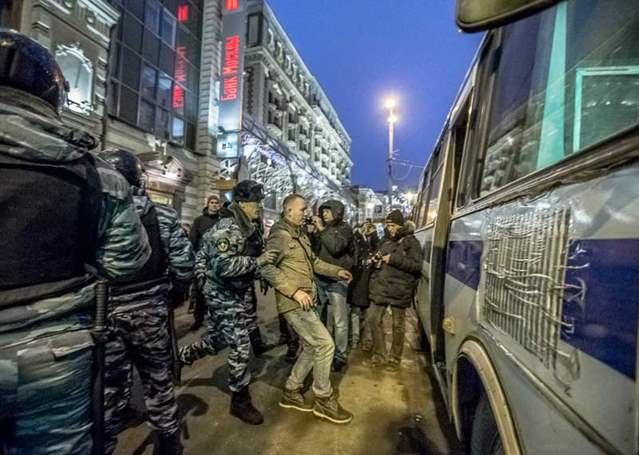
© Alexander Baroshin / Amnesty International
Police violently disperse a spontaneous protest in Tverskaya street after the verdict in the Bolotnaya case was delivered, Moscow, February 2014.
Press freedom
A free press reporting on the issues that interest us and shape our lives is a key building block of any rights-respecting society. Yet in Azerbaijan, Türkiye and Venezuela to name just a few countries, journalists face repression and attacks.
In June 2019, Tanzania’s parliament fast-tracked the passing of the Written Laws Bill, which would entrench censorship, among other violations. Journalists in the country already operate within the tight confines of a media law that requires media houses to “broadcast or publish news or issues of national importance as government may direct”.
In July 2019, the libel trial began in the Philippines against Maria Ressa, the executive editor of online news outlet Rappler. Ressa, a prominent critic of President Rodrigo Duterte, was arrested in February 2019 on trumped up libel charges after Rappler published detailed investigations into some of the thousands of extrajudicial executions committed by police and unknown armed persons, with Duterte’s explicit encouragement, during drugs-related operations. Her case is widely seen as an attack by the government on press freedom.
During conflict, repression can get worse, such as in Myanmar where journalists investigating the killing of Rohingya men and boys by security forces in Rakhine State were arrested and jailed, before being freed under international pressure.
Freedom of speech
Freedom of speech, or freedom of expression, applies to ideas of all kinds, including those that may be deeply offensive. While international law protects free speech, there are instances where speech can legitimately restricted under the same law – such as when it violates the rights of others, or, advocates hatred and incites discrimination or violence.
However, any restrictions on freedom of expression must be provided by law, protect certain public interests or the rights of others and, be clearly necessary for that purpose. .
In 2018, Amnesty International published research that found that Twitter is a platform where violence and abuse against women flourish, often with little accountability. Instead of the platform being a place where women can express themselves freely and where their voices are strengthened, Twitter leads women to self-censor what they post and limit their interactions. As a company, Twitter is failing its responsibility to respect women’s rights online by inadequately investigating and responding to reports of violence and abuse in a transparent manner.
The digital frontier
The digital world gives many more of us access to the information we need, including to challenge governments and corporations. Information is power and the internet has the potential to significantly empower the world’s seven billion people.
But freedom of expression today still often depends on wealth, privilege and our place in society. Those who are rich and powerful are seldom restricted in expressing their views.. Similarly, those who have their own laptops with broadband, have far greater access to information than those who have to walk miles to an internet café.
Increasingly, some states try to build firewalls around digital communications, or in the case of Egypt, Sudan and Zimbabwe among others, respond to mass street protests with an internet shutdown. Iran, China and Viet Nam have all tried to develop systems that enable them to control access to digital information. In India’s northern Kashmir region, mobile Internet and communications are suspended in response to any unrest. At Amnesty International, we are continually finding new ways to stop our website being blocked in China.
Governments are also using dangerous and sophisticated technologies to read activists and journalists’ private emails and remotely turn on their computers’ camera or microphone to secretly record their activities. In 2014, Amnesty and a coalition of human rights and technology organizations launched ‘Detekt’ – a simple tool that allows activists to scan their devices for surveillance spyware.
What is Amnesty doing to protect the freedom of expression?
Case study: Poland and the right to protest
Amnesty International has documented how people in Poland have taken to the streets to express their opinions despite restrictive legislation combined with heavy-handed policing, surveillance, harassment and prosecution which threaten to strangle the right to peaceful protest.
Since 2016, tens of thousands of people have protested against repressive legislation aimed at curbing women’s rights and undermining the independence of the judiciary. Protesters have routinely been met with a show of force and restrictive measures that infringe their right to be seen and heard. Hundreds have found themselves in police custody and facing lengthy court proceedings.
In parallel with tightening the laws affecting the exercise of the right to freedom of peaceful assembly, the government has vastly expanded the surveillance powers of law enforcement agencies with evidence that these expanded powers have been used against people engaged in organizing and participating in peaceful protests.
Case study: Surge in Vietnamese prisoners of conscience
In 2019, Amnesty released shocking research showing that the number of prisoners of conscience unjustly jailed across Viet Nam had sharply risen by a third in signs of a growing crackdown on peaceful activism by lawyers, bloggers, human rights defenders, environmental activists and pro-democracy campaigners.
The prisoners’ detention conditions remain appalling with evidence of people being tortured and otherwise ill-treated, routinely held incommunicado and in solitary confinement, kept in squalid conditions and denied medical care, clean water and fresh air.
Many prisoners of conscience were jailed for comments made on social media platforms and were targeted using the vague and overly broad provisions of the penal code.
One prisoner of conscience is Tran Hoang Phuc. A pro-democracy and environmental activist, he was arrested in June 2017. Tried and convicted on charges of ‘conducting propaganda against the state’ for making and sharing videos perceived to be critical of the government on social media, he was sentenced to six years in prison, followed by four years under house arrest.
The Solution: What is Amnesty calling for?
- Prisoners of conscience around the world should be released immediately and unconditionally.
- All laws criminalizing people who speak out or protest peacefully, should be struck off the law books.
- Laws against hate speech or other incitement to discrimination and violence must not be used to repress peaceful dissent.
- People should have access to information, and the power of governments and companies to obtain information about individuals and organisations must be restricted.
Question of the day - What is one controversial or unpopular belief you hold, and why do you feel it's important to be able to express it freely?
Rights & Freedom
What is one controversial or unpopular belief you hold, and why do you feel it's important to be able to express it freely?
Daily archives
Current Survey
Top 5 Contributors (Dec)

20209 pts

12060 pts

10714 pts

10417 pts

10117 pts