


- Abuse & The Abuser
- Achievement
- Activity, Fitness & Sport
- Aging & Maturity
- Altruism & Kindness
- Atrocities, Racism & Inequality
- Challenges & Pitfalls
- Choices & Decisions
- Communication Skills
- Crime & Punishment
- Dangerous Situations
- Dealing with Addictions
- Debatable Issues & Moral Questions
- Determination & Achievement
- Diet & Nutrition
- Employment & Career
- Ethical dilemmas
- Experience & Adventure
- Faith, Something to Believe in
- Fears & Phobias
- Friends & Acquaintances
- Habits. Good & Bad
- Honour & Respect
- Human Nature
- Image & Uniqueness
- Immediate Family Relations
- Influence & Negotiation
- Interdependence & Independence
- Life's Big Questions
- Love, Dating & Marriage
- Manners & Etiquette
- Money & Finances
- Moods & Emotions
- Other Beneficial Approaches
- Other Relationships
- Overall health
- Passions & Strengths
- Peace & Forgiveness
- Personal Change
- Personal Development
- Politics & Governance
- Positive & Negative Attitudes
- Rights & Freedom
- Self Harm & Self Sabotage
- Sexual Preferences
- Sexual Relations
- Sins
- Thanks & Gratitude
- The Legacy We Leave
- The Search for Happiness
- Time. Past, present & Future
- Today's World, Projecting Tomorrow
- Truth & Character
- Unattractive Qualities
- Wisdom & Knowledge






FOLLOWERS
0
Users
Happiness Tuesdays
Good Business Policy
Having solid business policies tends to help businesses to be more ethical in their dealings, in my opinion.
Without established policies, every scenario gets treated differently and one person might end up with a more favorable outcome than the next, simply because a procedure or policy does not exist.
Consistency and fairness are key pillars of good governance within any organization. When policies are clearly defined and consistently applied, it creates a predictable and equitable environment for both employees and customers. This not only fosters trust but also reduces the potential for disputes and misunderstandings.
I remember a time in my business when someone accused us of unfair treatment. Thankfully, we had well established procedures that were posted on our website. We applied these policies to every scenario so that we knew that we were being equitable to all of our customers. We were able to say this to our customer who was upset because we wouldn’t refund her when the request was outside our refund window. We explained to her that in order for us to have integrity in our business, we had to follow our policies, otherwise she would be getting special treatment that other people did not receive.
I like to think of it like a set of rules for a game. If the rules are vague or constantly changing, players will feel frustrated and the game itself becomes chaotic. The same principle applies to business. Well-defined policies act as a compass, guiding actions and decisions, and ensuring that everyone is playing by the same rules.
Clearly articulated policies can significantly enhance a company's reputation. Businesses known for their ethical practices and fair dealings tend to attract and retain better talent, foster stronger customer loyalty, and ultimately, achieve greater long-term success. It's not just about doing the right thing; it's also about building a sustainable and thriving business that acts with integrity.
Interesting Fact #1
Personnel Policies – Clearly state business hours, code of conduct, terms of employment (hiring and termination), wages or salary (and bonuses, if any), insurance and health benefits, paid vs. unpaid vacation days, sick leave, and retirement.
Interesting Fact #2
Disciplinary Action Policies – Address issues of honesty, performance, safety, and misconduct, and determine what constitutes a violation of company policy, as well as how employees will be disciplined if they violate certain rules.
Interesting Fact #3
Safety Policies– Use industry best practices and relevant local, state, and federal laws as guidelines to create rules detailing what safe behavior at work looks like, how to use safety equipment, how to report safety hazards, etc.

Quote of the day
“If you had to identify, in one word, the reason why the human race has not achieved, and never will achieve, its full potential, that word would be 'meetings.” ― Dave Barry
Article of the day - Company Policies: 17 Policies to Consider for Your Business
When an organization has clear company policies, both employees and employers benefit. Outlining employees’ rights and expectations within your company helps set behavioral and performance standards for the workplace, and gives employees an overall framework of how to be successful at your company. Company policies also help to protect your business and contribute to a safe and more enjoyable work environment for everyone.
There are business policies that you may need to comply with according to law, but you may also choose to develop your own policies as well. Below, you’ll find tips and best practices to help you decide what policies to add to your employee handbook.
Start your job posting, instantly
What are company policies?
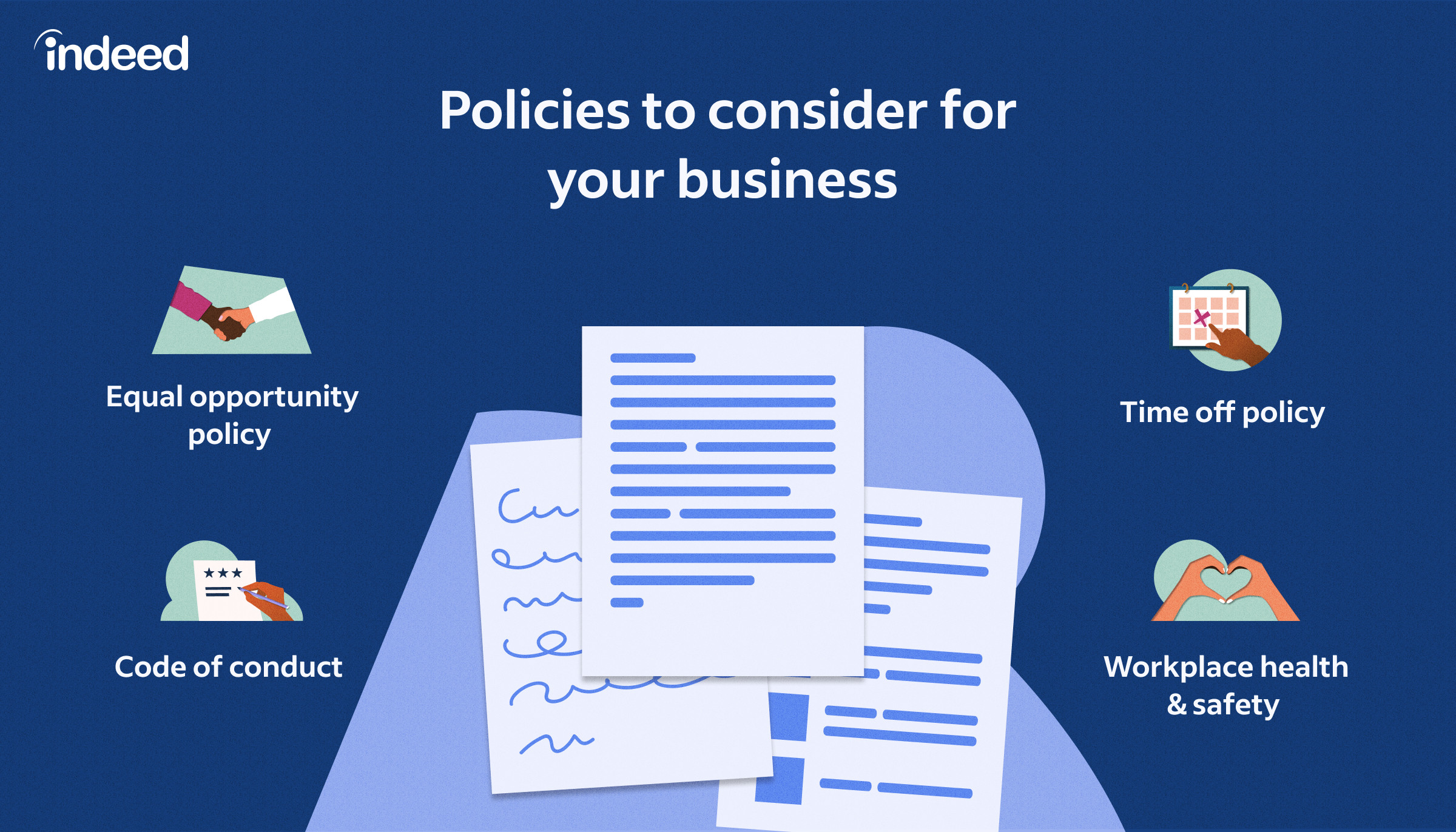
Company policies are guidelines that help employers deal with the health, safety and accountability of employees, as well as their interactions with customers or clients. Business policies can also be used as a guideline for federal or state regulatory requirements, legal issues and other situations that can lead to severe consequences for employees.
Here’s a list of company policies you may need:
- Equal opportunity policy
- Workplace health and safety
- Employee code of conduct policy
- Attendance, vacation and time-off policies
- Employee disciplinary action policy
- Employee complaint policies
- Ethics policy
- Work schedule and rest period policies
- Substance abuse policies
- Workplace security policies
- Bring Your Own Device (BYOD) policies
- Compensation and benefits policy
- Travel policies
- Employee fraternization policy
- Inclement weather policies
- Employee face mask policy (during COVID-19)
- Remote work policy
Why are company policies important?
Company policies put in writing what you expect from your employees. These may be related to performance, values or behavior. Additionally, company policies can serve as pre-warnings for employees, since they outline the consequences of failing to abide by the rules.
Company policies are important for a variety of other reasons, including:
- Setting expectations
- Keeping management accountable
- Ensuring compliance with the law
- Helping defend against legal claims
- Assisting with fair treatment of employees
List of company policies to consider creating
Here are some of the policies that your company should consider putting in place:
1. Equal opportunity policy
Many countries mandate that you must be an equal opportunity employer by law. For example, in the United States, the U.S. Equal Employment Opportunity Commission enforces a wide range of federal laws that prohibit workplace discrimination.
An equal opportunity policy (EOP) prevents companies from discriminating against job applicants or employees if they are a member of a protected class (e.g, race, gender, age, religion, familial status, color). The EOP is essential for any anti-harassment, workplace violence, non-discrimination or diversity policies your company may consider developing.
2. Workplace health and safety
It’s important to provide your employees with a safe and healthy work environment, especially since workplace health and safety violations can cause harm to your employees, cost your business money and damage your reputation.
Your business should be proactive and write a health and safety policy that is designed for each workplace. For example, you might specify what employees should do in case of office emergencies or how to handle unsafe materials. The Occupational Safety and Health Administration (OSHA) has guidelines on how to create a safe workplace and protect workers from occupational hazards that you can base your policy on.
3. Employee code of conduct policy
A clear and concise code of conduct can help employees understand your r expectations in terms of performance and behavior. This policy might include specific rules related to substance abuse, sexual harassment, giving gifts, dress code, confidentiality, and even the use of cell phones or social media during work hours.
Misunderstandings may still occur, but at least employees have something to refer to if they’re unsure about what your expectations are.
Here’s an example of a policy you could include in your code of conduct regarding employee discrimination and harassment:
WMB Company is committed to eradicating discrimination and unlawful harassment in our workplaces. Any actions, jokes or comments based on an employee or client’s race, religion ethnicity, sex, age or any other legally protected class are not tolerated and will be met with significant disciplinary action.
4. Attendance, vacation and time-off policies
Having a standard way to request a day off or take vacation leave will help things run more smoothly in the office. A PTO policy should outline how much time off employees receive, when and how they can accrue more time off, who they should contact to request their time off and anything else they may need to know about taking PTO (e.g., is vacation use-it-or-lose-it?). Other time off policies to consider creating include parental leave policies and bereavement leave policies.
You can also choose to create a separate attendance policy or no call no show policy that outlines what is considered tardy, how far in advance they should request time off and what happens if they don’t show up for work.
Here’s an example of a company attendance policy you can use to help write your own:
Employees are expected to be on time and regular in attendance. This means being at your workspace and ready to work at your scheduled time each day. You will be given a 10-minute grace period after the start of your shift before you will be considered tardy. Employees who are tardy on more than five occasions will be subject to disciplinary action. Absenteeism and tardiness are burdensome to your co-workers and leaders, and will not be tolerated without just cause.
4. Employee disciplinary action policy
Some of the most important company policies involve discipline and employee conduct. Before you can hold your employees accountable for their actions, it’s important to record your expectations in terms of performance and behavior in your employee handbook or individual employee contracts. With complete access to the rules and regulations of the workplace, you can then enforce disciplinary action when appropriate while using the employee handbook as a point of reference.
A simple step-by-step list of what happens regarding disciplinary action can make it easy for employees to know what to expect if they violate a company policy. Describe a specific process you will follow to ensure every employee is treated fairly when it comes to discipline. Have a lawyer review this information before you include it in your employee handbook to make sure all disciplinary action is legal.
Check out how to create a disciplinary action policy for your company here.
6. Employee complaint policies
Grievances are formal complaints your employees can file to document their concerns with an aspect of their workplace. These grievances might be filed as a result of an incident or conflict with a fellow employee. A grievance can be filed for nearly any reason, including physical workplace complaints, financial issues like payroll and social circumstances like harassment or bullying. It’s important to outline a formal process for resolving complaints within your company so that employees know how to handle their concerns in a professional way.
It may also be a good idea to develop a non-retaliation policy to protect employees who make good faith complaints against their manager or co-workers.
Related: Employee Complaints: Properly Listening to Team Members
How to develop company policies as an employer
If you want to develop business policies to address important workplace issues, consider following the steps below:
1. Identify the need for the policy
Observe the way your management and employees deal with workplace issues, and identify which areas could use improvement. For instance, if employees consistently violate unwritten rules, you may consider adding a new policy that addresses this and other related issues.
Read more: How to Implement HR Policies
2. Determine the content needed for the policy
Write down key areas that need to be addressed within the policy. For instance, you can include different sections or clauses that prevent you or your employees from finding loopholes. Consider all aspects of the policy, what you would like your employees to do and what you would like them to avoid doing. It’s also a good idea to include what form of disciplinary action will be taken if a policy is violated.
Consider checking with an attorney before distributing any policies to employees.
3. Communicate the new policy to employees
Current employees need to be notified of new policies when they’re released or added to the employee handbook. You may even consider adding a signature line to the new policy to make sure employees know that they must follow the rule from the date they sign it. This prevents conflict later on if an employee states they were never aware of the policy after receiving disciplinary action for violating it.
It’s also important to review and discuss company policies with new employees during onboarding so they know what to expect. Consider having them sign a form stating that they were given an employee handbook or a list of your policies, rules and regulations.
4. Update and revise the policy as necessary
You may consider amending or revising your policies as necessary in accordance with laws and regulations or according to your company’s objectives and any employee feedback.
Recent HR policies articles
- Creating a Strong Foundation: How to Implement HR Policies Successfully
- How to Create a Paid Time Off Policy
- Asynchronous Communication: How to Use It for Remote Work Success
- HCM vs. HRIS vs. HRMS: What Are the Differences?
- ATS and CRM: What Are the Differences?
*Indeed provides this information as a courtesy to users of this site. Please note that we are not your recruiting or legal advisor, we are not responsible for the content of your job descriptions, and none of the information provided herein guarantees performance.
Question of the day - What is one business policy you believe is essential for any organization, and why?
Politics & Governance
What is one business policy you believe is essential for any organization, and why?
Daily archives
Current Survey
Top 5 Contributors (Dec)

20209 pts

12060 pts

10714 pts

10417 pts

10117 pts