




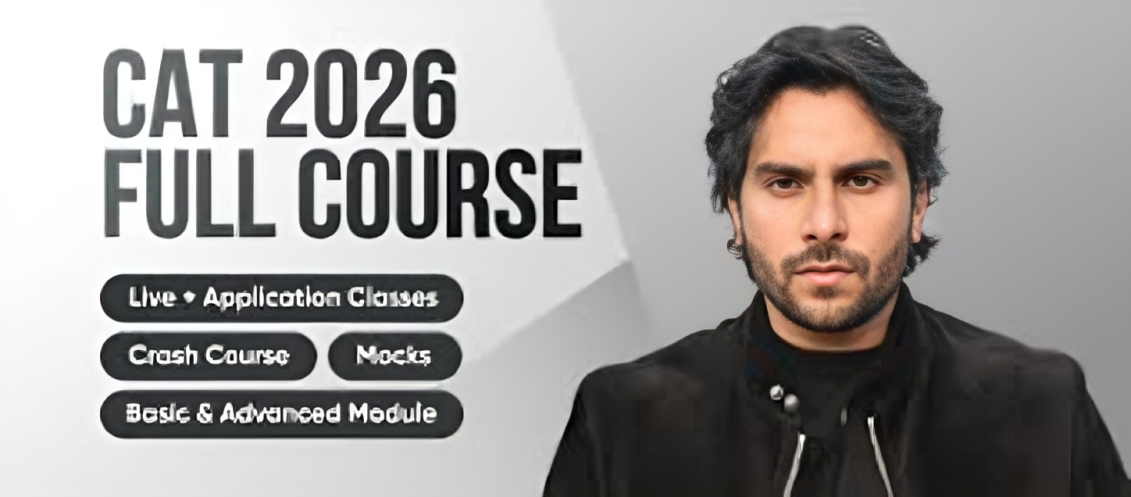
Preparing for the CAT can feel daunting — with syllabus breadth, time pressures, and fierce competition for top percentiles. A structured CAT 2026 course can make all the difference by offering a guided path: concept-building, rigorous practice, mocks, doubt-support and strategy. Below, we break down what a comprehensive CAT 2026 Course should ideally include — syllabus coverage, strategy roadmap, and coaching support — to help you decide wisely.
What a Good CAT 2026 Course Covers – Syllabus Breakdown
A robust CAT course prepares you thoroughly across all three major sections of CAT: Quant, LRDI (Logical Reasoning & Data Interpretation), and VARC (Verbal Ability & Reading Comprehension). A well-designed course starts from basics and scales up to advanced CAT-level problems, helping aspirants crack the CAT 2026 Course with the right strategy and coaching.
- Quant (QA)
- Topics generally include school-level mathematics (arithmetic, algebra, geometry, number systems), plus advanced or application-oriented areas like permutations & combinations, probability, inequalities, functions, etc.
- LRDI (Logical Reasoning & Data Interpretation)
- Focus on various types of DI (charts, graphs, tables) and LR — including arrangements, games/tournaments, selections, logic puzzles, network/flow diagrams, Venn Diagrams etc.
- VARC (Verbal Ability & Reading Comprehension)
- Includes reading comprehension passages, para-summary, para-jumbles, odd-one-out, para-completion, vocabulary/grammar where relevant.
A well-structured course will usually have:
- Foundation-level modules (especially for students lacking strong basics).
- Conceptual classes + application/practice sessions: learning the theory, then applying it via problems.
- Ample practice material: topic-wise assignments, large question-banks, mocks & sectionals.
Strategy: How to Progress with a CAT 2026 Course
A smart strategy matters as much as the course content. Here’s a commonly adopted roadmap for CAT aspirants aiming high percentile:
- Start Early with Basics + Syllabus Coverage
- Begin with foundation modules — especially important for non-engineers or those whose basics are weak. Build a strong grasp on Quant fundamentals, logical reasoning basics, and reading comprehension essentials.
- Concept + Application + Revision
- Use conceptual classes to understand theory → then move to application sessions and problem sets to practice those concepts. Regular assignments and mock-style questions help internalize shortcuts and strategies.
- Regular Mock Tests and In-depth Analysis
- Mocks are vital: they simulate real exam conditions. After each mock, spend significant time analysing mistakes, identifying weak areas, and plugging gaps. Strategy must evolve with performance.
- Time-Bound Practice & Revision (Crash / Final Revision Phase)
- As exam approaches, engage in revision through crash-course modules, targeted mocks & sectional practice to sharpen speed, accuracy, and exam temperament.
- Consistent Doubt-Solving & Mentorship Support
- For sections you struggle with, regular doubt clarification and mentorship (if available) help maintain momentum and avoid conceptual gaps.
What Coaching & Support Looks Like in a Comprehensive Online CAT Course
An effective online CAT 2026 course often provides:
- Live Interactive Classes + Recorded Sessions — so you can attend live or watch recordings later if you miss.
- Section-wise Modules (Quant, LRDI, VARC), often with separate tracks for beginners/non-engineers and advanced learners.
- Assignments, Practice Sets & Topic-wise Questions — so that after each class you get enough practice to solidify your learning.
- Test Series & Mocks + Mock Analysis — Full mocks, sectional mocks, previous-year questions, performance analysis, all aimed at replicating the real CAT experience.
- Doubt-Solving and Discussion Community — 24×7 doubt-clarification, peer/community support, often via dedicated forums/groups.
This blend of structured content + flexibility + support helps many aspirants manage CAT prep alongside college or work.
Pros and Cons: What to Keep in Mind when Choosing a Course
What works:
- Comprehensive coverage across QA, LRDI, VARC — from basics to advanced.
- Flexibility: live + recorded sessions, practice anytime, ideal for students from any city (even those far from major coaching centres).
- Discipline & structure: syllabus roadmap, regular mocks & assignments — helps keep preparation on track.
What to check carefully:
- Ensure the mocks and practice questions are truly at CAT level — not too easy or trivial.
- Make sure doubt-support and mentorship aren’t limited to group chats or scattered resources; clarity and structure matter.
- Maintain consistency: a good course helps, but personal discipline, regular practice, and self-study are essential to hit high percentiles.
Who Should Go for a Full CAT 2026 Course — and Who Might Self-Study
Recommended for:
- Students with weak fundamentals (especially non-engineers) who need structured basics + concept clarity.
- Busy college students or working professionals who need flexibility: recorded sessions, online mocks, self-paced learning.
- Aspirants aiming for 99 %ile+ or IIM calls, who need systematic preparation, mocks, strategy and discipline.
Possibly skip full course if:
- You already have strong fundamentals in Quant, LRDI & VARC, and are disciplined enough for self-study + mocks.
- You want to save money and can leverage good books + previous year papers + free online resources + regular mocks.
Conclusion
A well-designed CAT 2026 course — covering full syllabus across Quant, LRDI, VARC, combining conceptual classes, heavy practice, mocks with analysis, doubt support and final-phase revision — can be a powerful accelerator in your CAT journey. However, the success depends equally on your consistency, practice and learning attitude.
If you are a non-engineer or someone looking for structure and guidance or balancing studies/work along with CAT prep — enrolling in a full CAT 2026 course makes sense. But if you’re confident about basics and motivated for self-study, with smart use of mocks, past-year papers and free resources — you could make good progress independently too.
Comments