




Introduction: The Rise of Intelligent Digital Systems
Modern digital systems are no longer passive tools. They actively learn from data, recognize complex patterns, predict future outcomes, and even generate new content that resembles human creativity. This evolution has reshaped how software is developed, how decisions are made, and how technology interacts with people.
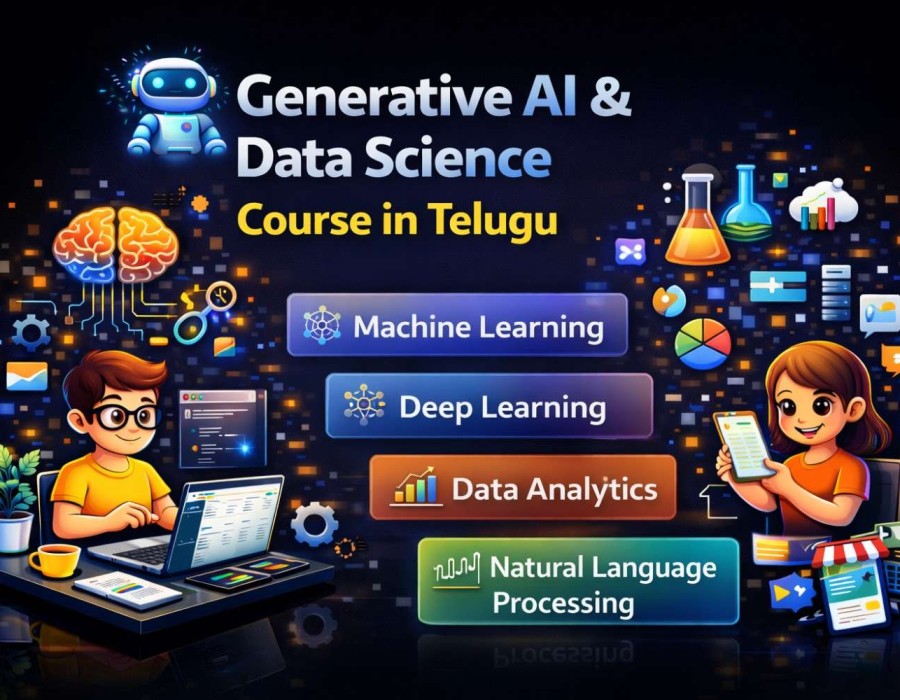
As a result, many learners are drawn toward a Generative AI & Data Science Course in Telugu to understand how intelligent systems are actually built. Data Science provides the analytical structure that helps systems learn from information, while Generative AI extends that learning into creation and simulation. Together, they represent the core of modern artificial intelligence.
Data Science as the Foundation of Intelligent Logic
Data Science is the discipline that enables systems to reason with data. It is not about collecting information randomly but about understanding what data represents and how it can be used responsibly.
At its foundation, Data Science focuses on:
- Defining meaningful problems
- Collecting relevant and reliable data
- Preparing data for analysis
- Discovering patterns and relationships
- Making decisions supported by evidence
This approach replaces assumptions with measurable reasoning.
Why Data Shapes Modern Technology
Every interaction in the digital world creates data. From user activity to machine logs, information flows continuously. However, data alone does not create intelligence. Intelligence emerges when data is analyzed correctly.
Data-driven systems help organizations:
- Understand behavior and trends
- Measure performance accurately
- Forecast future outcomes
- Reduce uncertainty in decision-making
Data Science provides the structured methods required to turn data into insight.
Core Stages of the Data Science Process
Data Collection and Preparation
Most real-world data is imperfect. It may be incomplete, inconsistent, or noisy. Preparing data is one of the most critical steps in Data Science.
This stage involves:
- Removing duplicate or incorrect entries
- Handling missing values
- Standardizing data formats
- Ensuring overall data consistency
High-quality analysis depends on high-quality data.
Exploring Data to Discover Patterns
Exploratory Data Analysis helps analysts understand what the data is revealing before any models are built.
This process includes:
- Visualizing distributions and trends
- Identifying correlations
- Detecting anomalies
- Understanding relationships between variables
Exploration builds intuition and guides analytical direction.
Statistical Thinking and Validation
Statistics provide the mathematical backbone of Data Science.
They help practitioners:
- Measure uncertainty
- Test hypotheses
- Validate analytical conclusions
- Avoid misleading interpretations
Statistical discipline ensures that insights are reliable and repeatable.
Machine Learning as Data-Driven Learning
Machine learning enables systems to learn patterns from data rather than relying on fixed rules.
It allows:
- Predicting future events
- Classifying and grouping data
- Detecting complex relationships
- Improving accuracy over time
Machine learning transforms static analysis into adaptive intelligence.
Generative AI: Beyond Analysis into Creation
Traditional AI models focus on analyzing data or making predictions. Generative AI introduces a new capability—the ability to create new outputs based on learned patterns.
Generative AI systems can:
- Generate text, images, audio, or code
- Simulate conversations and scenarios
- Create synthetic datasets
- Assist with creative and analytical tasks
This ability expands AI’s role from interpretation to generation.
How Generative AI Learns to Create
Generative AI models study large volumes of data to understand structure and context.
They learn:
- Probability distributions
- Sequential relationships
- Contextual meaning
Using this understanding, they generate new outputs that follow learned patterns without copying original data.
The Dependency Between Data Science and Generative AI
Generative AI does not operate independently. It relies heavily on Data Science.
Data Science:
- Ensures data quality
- Provides evaluation frameworks
- Detects bias and inconsistency
- Validates generated outputs
Without Data Science, Generative AI risks becoming unreliable or misleading.
Real-World Influence of Data Science
Data Science impacts nearly every industry.
Examples include:
- Finance: fraud detection and risk modeling
- Healthcare: patient data analysis and diagnostics
- Retail: demand forecasting and personalization
- Manufacturing: quality control and optimization
- Transportation: route planning and safety analysis
Each application depends on structured data reasoning.
Real-World Influence of Generative AI
Generative AI enhances productivity and creativity across domains.
It is used for:
- Intelligent virtual assistants
- Automated content creation
- Code generation and debugging
- Design and ideation workflows
- Simulation and training environments
Generative AI supports innovation by augmenting human capabilities.
Ethical and Responsible Use of AI and Data
As intelligent systems become more powerful, ethical responsibility becomes essential.
Key considerations include:
- Protecting data privacy
- Reducing bias in training data
- Ensuring transparency in model behavior
- Maintaining accountability for outcomes
Responsible AI ensures long-term trust and sustainability.
Skills Developed Through Learning These Technologies
Learning Data Science and Generative AI builds a strong intellectual toolkit.
Key skills include:
- Analytical and critical thinking
- Data interpretation
- Pattern recognition
- Logical problem-solving
- Evidence-based decision-making
These skills are applicable across industries and roles.
Why Learning in Telugu Supports Better Understanding
Learning advanced topics like Data Science and Generative AI in Telugu helps learners understand complex logic, mathematical reasoning, and AI workflows without language barriers. Familiar language improves clarity, builds confidence, and enables learners to connect theoretical concepts with real-world understanding more effectively.
How AI Is Transforming the Nature of Work
AI systems are designed to assist human intelligence, not replace it.
They help by:
- Automating repetitive analysis
- Enhancing creative workflows
- Increasing speed and accuracy
- Supporting informed decision-making
Human judgment remains central to meaningful outcomes.
The Future Path of Data Science and Generative AI
These fields continue to evolve rapidly.
Key trends include:
- AI-assisted analytics
- Automated model development
- Synthetic data generation
- Explainable and ethical AI
- Personalized intelligent systems
Human–AI collaboration will deepen further.
Learning as a Continuous Process
Mastering Data Science and Generative AI requires patience and conceptual clarity.
A strong learning approach emphasizes:
- Foundational statistics and logic
- Hands-on data exploration
- Understanding model behavior
- Continuous evaluation and improvement
Depth of understanding ensures long-term growth.
Long-Term Value of These Skills
Generative AI and Data Science represent a long-term shift in how intelligence is embedded into technology.
Their value lies in:
- Broad industry relevance
- Alignment with future innovations
- Strong analytical foundations
- Continuous learning opportunities
These skills grow more valuable with experience.
Conclusion: Intelligence Built on Data and Creation
Data Science and Generative AI together define how modern intelligent systems are designed and operated. Data Science provides structure, logic, and evidence-based reasoning, while Generative AI extends these foundations into creative and adaptive capabilities.
Exploring a Generative AI & Data Science Course in Telugu offers a structured and clear path to understanding this powerful combination. This knowledge builds not only technical expertise but also a way of thinking grounded in data, responsibility, and intelligent innovation—qualities that are essential in an increasingly AI-driven digital world.
Comments