




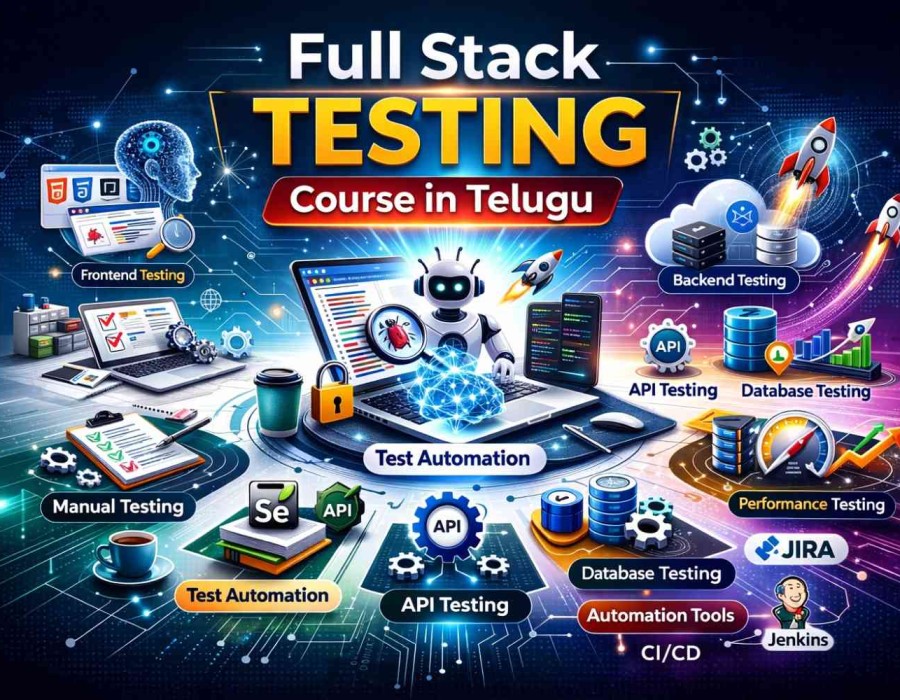
Introduction: From Tester to Quality Engineer
Many people begin their journey in software testing by learning manual test cases and reporting defects. But today’s industry expectations have changed.
Companies no longer look for testers who only execute test cases. They prefer professionals who:
- Understand application architecture
- Automate regression suites
- Validate APIs
- Verify database accuracy
- Integrate tests into CI/CD pipelines
- Analyze performance bottlenecks
This shift has created demand for Full Stack Testers.
That is why many learners search for a Full Stack Testing Course in Telugu to understand how to grow from basic testing knowledge to complete quality engineering expertise.
Full Stack Testing is not a single skill — it is a roadmap that connects multiple technical areas.
What Is Full Stack Testing?
Full Stack Testing refers to validating all layers of a software application, including:
- User Interface (Frontend)
- Backend Business Logic
- APIs and Services
- Database Systems
- Integration Between Modules
- Performance and Load Handling
- Security Controls
- Continuous Deployment Pipelines
It ensures the system works as a unified and reliable product.
Step 1: Build a Strong Manual Testing Foundation
Every Full Stack Tester begins with manual testing fundamentals.
Key concepts include:
- SDLC (Software Development Life Cycle)
- STLC (Software Testing Life Cycle)
- Requirement analysis
- Test case writing
- Bug reporting
- Functional and regression testing
Manual testing builds analytical thinking and system understanding.
Step 2: Learn UI Automation
Once fundamentals are strong, the next step is UI automation.
UI automation ensures:
- Faster regression testing
- Cross-browser validation
- Stable release cycles
Common tools:
- Selenium
- Cypress
- Playwright
Programming knowledge (Java or Python) is usually required for automation scripting.
Automation increases efficiency and reduces repetitive manual effort.
Step 3: Master API Testing
Modern applications rely heavily on APIs.
API testing verifies:
- Correct request-response structure
- Status code validation
- Authentication handling
- Error message verification
Tools commonly used:
- Postman
- REST Assured
API testing is critical in microservices-based systems.
Step 4: Understand Backend Logic
Backend testing involves verifying:
- Business rules
- Conditional logic
- Data transformation
- Exception handling
Even basic programming knowledge helps testers understand server-side behavior.
This step improves debugging ability.
Step 5: Learn Database Testing
Database testing ensures:
- Correct data insertion
- Accurate updates
- Proper joins and relationships
- Transaction consistency
SQL knowledge allows testers to verify backend operations at the data level.
Data validation is crucial for financial and enterprise systems.
Step 6: Explore Integration Testing
Integration testing checks:
- Frontend-backend communication
- Backend-database synchronization
- Service-to-service interaction
This ensures modules function together without failure.
Step 7: Performance Testing
Performance testing measures:
- Load capacity
- Stress tolerance
- Response times
- Scalability
Tools like JMeter simulate heavy traffic.
Performance validation is critical for high-traffic applications.
Step 8: Learn DevOps and CI/CD Integration
Modern development uses continuous integration pipelines.
Full Stack Testing integrates with:
- Jenkins
- GitHub Actions
- Docker
- Kubernetes
Automated tests run during build and deployment.
This approach is called Continuous Testing.
Core Tools Ecosystem in Full Stack Testing
A Full Stack Tester may work with:
- Selenium for UI automation
- Postman for API testing
- SQL for database validation
- JMeter for performance testing
- Git for version control
- Jenkins for CI/CD
Understanding how these tools connect is essential.
Skills Required to Become a Full Stack Tester
To build expertise, learners should develop:
- Strong analytical thinking
- Programming basics
- Automation framework knowledge
- API testing skills
- Database query expertise
- CI/CD pipeline awareness
- Communication skills
Full Stack Testing combines technical depth and system understanding.
Why Full Stack Testing Is in High Demand
Organizations value Full Stack Testers because they:
- Work across multiple layers
- Reduce cross-team dependency
- Improve release speed
- Prevent production defects
- Support DevOps workflows
Multi-skilled testers bring efficiency and reliability to projects.
Why Learn Full Stack Testing in Telugu?
Understanding automation frameworks, API communication, database validation, and CI/CD integration concepts in Telugu can improve foundational clarity during early learning stages.
Career Opportunities in Full Stack Testing
Professionals with Full Stack Testing expertise can pursue roles such as:
- Automation Engineer
- API Testing Specialist
- QA Analyst
- Performance Test Engineer
- DevOps QA Engineer
- Quality Engineering Lead
The scope continues expanding with cloud-native applications.
Industry Trends and Future Scope
The future of Full Stack Testing includes:
- AI-driven automation tools
- Self-healing test frameworks
- Cloud-based testing environments
- Continuous quality engineering
- Shift-left testing practices
Testing is evolving into quality engineering.
Challenges in the Full Stack Testing Journey
Some common challenges include:
- Learning multiple technologies
- Debugging automation scripts
- Maintaining test frameworks
- Understanding distributed systems
- Keeping pace with tool updates
Practical exposure and project-based learning build confidence.
Broader Perspective on Career Growth
Full Stack Testing is more than learning tools.
It develops:
- System architecture understanding
- Deployment awareness
- Data integrity focus
- Performance analysis capability
- Security sensitivity
This holistic understanding strengthens long-term career growth.
Conclusion
Full Stack Testing plays a crucial role in ensuring application reliability across UI, backend logic, APIs, databases, performance layers, and DevOps pipelines.
By mastering automation, integration testing, performance validation, and continuous deployment workflows, learners can build strong foundations in modern quality engineering.
As the software industry continues evolving toward cloud-native and microservices architectures, the important question becomes — are you ready to follow the full stack testing roadmap and transform from a basic tester into a complete quality engineer?
Comments