




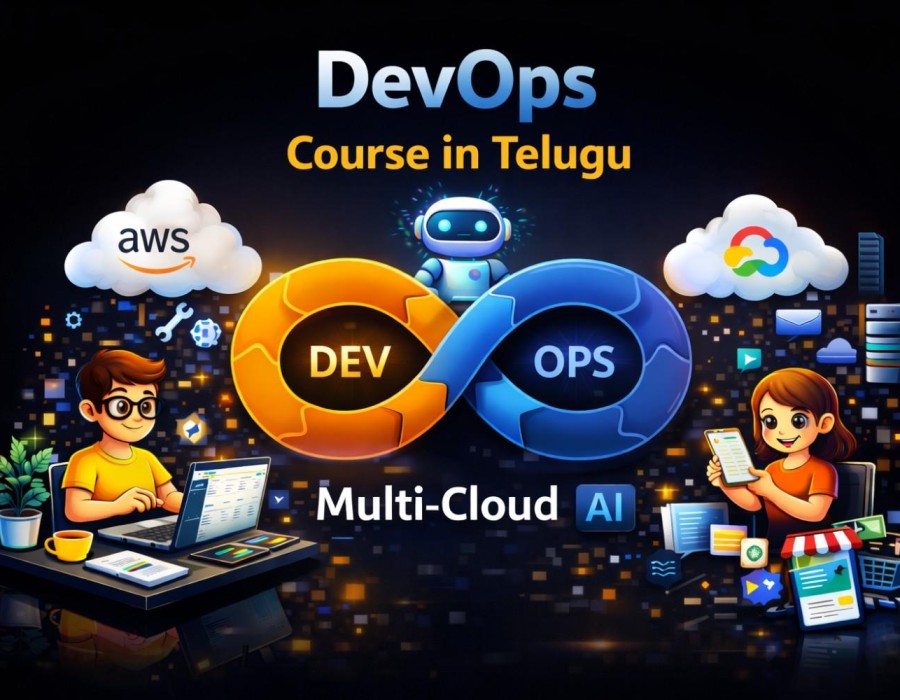
Introduction: Why DevOps Is Everywhere Today
Have you ever wondered how companies release new app features so quickly without shutting down their services? Or how large platforms handle updates without affecting millions of users?
Behind this speed and stability is a methodology called DevOps.
In today’s technology-driven world, software development is no longer just about writing code. It is about delivering reliable software quickly, efficiently, and securely. That is why interest in a devops course in telugu has grown significantly among students and IT professionals.
DevOps connects development and operations teams to improve collaboration, automation, and continuous delivery. Understanding this concept deeply is essential for modern software careers.
What Is DevOps?
DevOps is a combination of two words:
- Development (Dev)
- Operations (Ops)
Traditionally, developers wrote code, and operations teams deployed and maintained it. This separation often caused delays and communication gaps.
DevOps removes that gap.
It is a culture and set of practices that:
- Improve collaboration
- Automate processes
- Increase deployment speed
- Maintain system reliability
DevOps focuses on continuous integration, continuous delivery, monitoring, and automation.
Why DevOps Became Important
Modern businesses require:
- Faster software releases
- High system reliability
- Reduced downtime
- Scalable infrastructure
Without DevOps, software deployment can become slow and error-prone.
DevOps helps organizations:
- Release features quickly
- Detect issues early
- Improve team coordination
- Maintain production stability
Many global companies rely heavily on DevOps practices for smooth operations.
Core Principles of DevOps
DevOps is built on several important principles:
1. Collaboration
Developers and operations teams work together.
2. Automation
Manual tasks are replaced with automated workflows.
3. Continuous Integration (CI)
Code changes are integrated frequently into a shared repository.
4. Continuous Delivery (CD)
Applications are deployed automatically after testing.
5. Monitoring and Feedback
Systems are continuously monitored for performance and errors.
These principles improve efficiency and reduce production issues.
Tools Used in DevOps
A structured DevOps learning path includes tools such as:
Version Control
- Git
Continuous Integration Tools
- Jenkins
- GitHub Actions
Containerization
- Docker
Container Orchestration
- Kubernetes
Configuration Management
- Ansible
- Puppet
Cloud Platforms
- AWS
- Azure
- Google Cloud
Understanding how these tools work together is essential in DevOps engineering.
DevOps Lifecycle Explained
The DevOps lifecycle includes several stages:
- Plan – Define features and tasks
- Develop – Write and test code
- Build – Integrate code into applications
- Test – Automate testing
- Release – Prepare for deployment
- Deploy – Push updates to production
- Operate – Maintain system stability
- Monitor – Track performance and issues
This cycle repeats continuously.
Automation ensures that this lifecycle runs efficiently.
Role of Docker in DevOps
Docker allows developers to package applications with their dependencies.
Benefits include:
- Consistent environments
- Faster deployment
- Reduced compatibility issues
Containers ensure that applications run the same in development and production environments.
Kubernetes and Container Orchestration
When applications use multiple containers, managing them manually becomes complex.
Kubernetes automates:
- Container deployment
- Scaling
- Load balancing
- Fault tolerance
It is widely used in cloud-native environments.
Cloud Computing and DevOps
DevOps works closely with cloud platforms.
Cloud environments provide:
- On-demand infrastructure
- Scalability
- Resource management
- High availability
DevOps engineers often manage cloud resources and automate infrastructure provisioning.
Why Learn DevOps in Telugu?
Understanding automation pipelines, containerization concepts, and cloud workflows in Telugu can improve clarity during the foundational stages of DevOps learning.
Career Opportunities in DevOps
After gaining DevOps skills, professionals can work as:
- DevOps Engineer
- Cloud Engineer
- Site Reliability Engineer (SRE)
- Build and Release Engineer
- Automation Engineer
DevOps roles are considered high-demand positions globally.
Skills Required for DevOps
DevOps is not just about tools.
It requires:
- Basic programming knowledge
- Linux fundamentals
- Networking basics
- Problem-solving ability
- Understanding of system architecture
Soft skills like collaboration and communication are equally important.
Challenges in DevOps
DevOps introduces complexity in:
- Managing automation pipelines
- Securing cloud infrastructure
- Handling system failures
- Monitoring distributed systems
Continuous learning is necessary because tools and technologies evolve rapidly.
Industry Demand and Growth
Companies across industries adopt DevOps to:
- Reduce time-to-market
- Improve reliability
- Increase scalability
- Lower operational costs
DevOps expertise is relevant in startups, enterprise companies, SaaS platforms, and government systems.
The Future of DevOps
DevOps continues evolving with trends such as:
- Infrastructure as Code (IaC)
- GitOps
- AI-driven monitoring
- DevSecOps (security integration)
- Cloud-native architecture
Automation and reliability engineering are becoming core requirements in modern IT.
Conclusion
DevOps is not just a technical skill — it is a mindset focused on collaboration, automation, and continuous improvement.
By understanding tools like Docker, Kubernetes, CI/CD pipelines, and cloud platforms, professionals can contribute to building scalable and reliable software systems.
As organizations aim for faster releases and higher reliability, the real question is — are you ready to understand how modern software delivery works and become part of the automation-driven future of technology?
Comments