


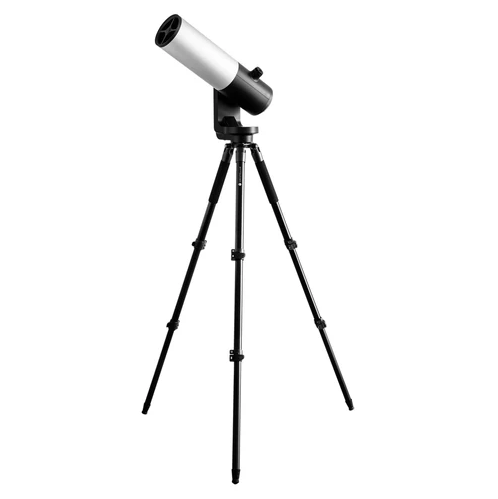
Smart telescopes are transforming how people explore the universe. Instead of relying on manual alignment, complex charts, and heavy equipment, a smart telescope uses automation, built-in imaging, and smartphone integration to make astronomy easier, faster, and more enjoyable for everyone. Whether you're a complete beginner or a seasoned space enthusiast looking for convenience, a smart telescope offers an exciting bridge between technology and the cosmos.

🌠 What Is a Smart Telescope?
A smart telescope is a fully automated, app-controlled telescope that combines traditional optics with advanced digital technology. Unlike manual telescopes, which require users to locate and track celestial objects themselves, smart telescopes use sensors, cameras, and software to do the work for you.
Key features include:
- Automated alignment: The telescope orients itself using star recognition and onboard computing.
- Digital imaging: Instead of an eyepiece, a camera captures the sky and sends the view to your phone or tablet.
- Image stacking: Multiple short exposures are combined to create bright, detailed pictures.
- Smart tracking: The telescope follows objects smoothly and accurately.
- App control: Users select targets, adjust settings, and save images with a single tap.
In short, a smart telescope blends astronomy with modern convenience, making the night sky more accessible than ever.
🔭 Why Smart Telescopes Are Gaining Popularity
Smart telescopes provide several powerful advantages that appeal to all kinds of stargazers:
1. Beginner-Friendly Operation
No experience? No problem. The telescope does all the work — from alignment to finding celestial objects — making it perfect for first-time observers.
2. Automatic Object Tracking
Once you choose a target, the telescope automatically locks onto it and keeps it centered, even as it moves across the sky.
3. Instant Astrophotography
You can capture deep-sky objects like nebulae and galaxies with little effort. Image stacking helps reveal details far beyond what your eyes could detect through a traditional eyepiece.
4. Great for Light-Polluted Areas
Smart telescopes use software enhancement to reduce glare, allowing you to enjoy views even from bright city locations.
5. Easy to Carry and Set Up
Most models are lightweight, portable, and require only a few minutes to begin observing — ideal for backyard, rooftop, or travel use.
6. Kid-Friendly and Family-Friendly
The app-based interface makes stargazing educational and interactive, perfect for sharing with family or friends.
⚠️ Limitations of Smart Telescopes
While smart telescopes are amazing tools, they do come with a few limitations:
Smaller Apertures
Smart telescopes often use smaller lenses or mirrors. This limits the telescope’s ability to produce crisp, high-magnification views of planets.
Closed System Design
Many smart telescopes don’t allow swapping eyepieces or upgrading components, as their design is integrated and automated.
Dependence on Apps and Power
Because they rely on software and internal batteries, poor connectivity or low battery life can interrupt a session.
Less Ideal for Serious Planetary Viewing
If your main goal is high-detail views of Jupiter’s storms or Saturn’s rings, a traditional optical telescope might still be the better choice.
🌟 Who Is a Smart Telescope Best For?
Smart telescopes are perfect for:
- Beginners who want to skip the learning curve
- Adults with limited time for setup and technical learning
- City dwellers dealing with moderate to heavy light pollution
- Casual astrophotographers who want stunning images without complicated gear
- Tech lovers who enjoy app-based control and automation
- Families or groups who want a shared, educational experience
- Travelers and campers who want a portable, easy stargazing solution
If you want fast, impressive results with minimal effort, a smart telescope might be your ideal choice.
🛰️ What You Can See With a Smart Telescope
Even in less-than-ideal sky conditions, a smart telescope can reveal:
- The Moon’s craters in sharp detail
- Bright planets like Jupiter, Saturn, Venus, and Mars
- Star clusters such as the Pleiades and M13
- Nebulae including Orion, Rosette, and Lagoon
- Galaxies like Andromeda, Bode’s Galaxy, and the Pinwheel
- Wide-field deep-sky objects with vivid colors and structure
The imaging technology truly shines with deep-sky objects, often showing features invisible to the naked eye.
🛠️ How to Choose the Right Smart Telescope
When selecting your smart telescope, keep these factors in mind:
1. Portability
If you want to travel or observe from multiple locations, go for a lightweight, compact design.
2. Battery Life
Longer battery life means longer observing sessions without interruption.
3. App Quality
Since the app controls everything, it should be intuitive, stable, and rich with features.
4. Imaging Capabilities
Check for clear resolution, fast stacking, and good low-light performance.
5. Budget
Smart telescopes range from entry-level to premium models. Choose one that fits your needs without unnecessary extras.
🌌 Final Thoughts
A smart telescope is one of the most exciting advancements in modern astronomy. By combining automation, imaging technology, and app-based control, it makes the universe easier to explore for beginners and experienced observers alike. Whether you're capturing deep-sky photos, learning the night sky, or simply enjoying a relaxing stargazing session, a smart telescope offers a powerful, user-friendly, and futuristic way to experience the cosmos.
And when you're ready to elevate your stargazing experience with high-quality astronomy equipment, Elite Telescopes is here to guide your journey among the stars.
Comments