


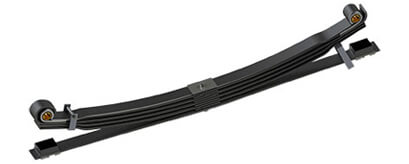
In the complex architecture of automotive suspension systems, the parabolic leaf spring stands out for its ability to deliver an exceptional balance between load-bearing capacity, ride comfort, and weight efficiency. Unlike traditional multi-leaf assemblies, the parabolic design relies on progressively varying thickness along the length of the spring. This geometry ensures that stress is distributed more uniformly, minimizing interleaf friction while optimizing deflection characteristics.
However, despite its advanced engineering, the durability of parabolic leaf springs is significantly affected by one of the most persistent material degradation phenomena in metal components—corrosion. The interaction between environmental conditions, surface coatings, and the microstructure of spring steel can lead to a gradual decline in performance, often culminating in catastrophic failure if unchecked.
This article explores the mechanisms, types, and effects of corrosion on parabolic leaf springs, examining how material science and preventive strategies can mitigate its influence on operational lifespan.
Understanding the Composition of Parabolic Leaf Springs
Parabolic leaf springs are typically manufactured from high-strength alloy steels, such as 55Si7, 60SiCr7, or SUP9, which possess high tensile strength and fatigue resistance. These steels are carefully heat-treated through tempering and quenching to achieve an optimal combination of hardness and flexibility.
However, the same microstructural characteristics that make these steels suitable for dynamic loading also render them vulnerable to corrosion under certain conditions. Fine pearlitic structures, for instance, may provide excellent strength but can form galvanic couples when exposed to moisture and electrolytes, accelerating localized corrosion.
The Corrosion Mechanism: A Material Science Perspective
Corrosion in parabolic leaf springs primarily arises due to electrochemical reactions occurring between the metallic surface and environmental agents such as water, oxygen, salts, and pollutants. The process begins when a potential difference develops across the steel surface, creating anodic and cathodic regions.
At the anodic sites, iron atoms oxidize to form ferrous ions:
Fe → Fe²⁺ + 2e⁻
Meanwhile, at the cathodic sites, oxygen reduction occurs:
O₂ + 2H₂O + 4e⁻ → 4OH⁻
The result is the formation of iron hydroxides, which further oxidize into iron oxides or rust (Fe₂O₃·xH₂O). This corrosion product occupies a larger volume than the original metal, leading to surface expansion, pitting, and microcracking.
Environmental Factors Accelerating Corrosion
- Moisture and Humidity
- Prolonged exposure to humid environments accelerates oxidation, especially in coastal or monsoon-prone regions. The film of moisture acts as an electrolyte, enhancing ion transport and corrosion rate.
- Salt Exposure
- Vehicles operating near coastal areas or in regions where roads are salted during winter face chloride-induced corrosion. Chloride ions disrupt the passive oxide layer on steel surfaces, allowing rapid rust propagation.
- Temperature Variations
- Fluctuating temperatures cause condensation cycles—moisture deposition during cooling and evaporation during heating—repeatedly initiating and accelerating corrosion.
- Contaminants and Road Debris
- Industrial pollutants, acidic rain, and road dust can alter surface pH and scratch protective coatings, creating initiation points for corrosion.
Types of Corrosion Affecting Parabolic Leaf Springs
- Uniform Corrosion
- Occurs evenly across exposed surfaces, leading to a gradual loss of material thickness. Although predictable, it reduces the load-carrying capacity over time.
- Pitting Corrosion
- Highly localized and dangerous, pitting forms microscopic holes that act as stress concentrators, significantly reducing fatigue life.
- Crevice Corrosion
- Found in areas where moisture or debris is trapped—such as under U-bolts or clamps—creating oxygen-deficient zones that accelerate metal dissolution.
- Fretting Corrosion
- Although parabolic leaf springs minimize interleaf friction, micro-movements between the spring and mounting surfaces can produce fretting wear, which initiates corrosion at contact points.
- Stress Corrosion Cracking (SCC)
- In the presence of tensile stress and corrosive agents, the steel may develop microscopic cracks that propagate over time, leading to sudden failure even without visible rusting.
Impact of Corrosion on the Functional Lifespan
Corrosion directly compromises both the mechanical integrity and functional performance of parabolic leaf springs:
- Reduction in Cross-Sectional Area: As corrosion removes material, the effective cross-section decreases, raising stress levels under the same load.
- Initiation of Fatigue Cracks: Pits and crevices act as nucleation sites for fatigue cracks, shortening fatigue life.
- Loss of Elastic Properties: Corroded regions alter the spring’s stiffness, leading to uneven load distribution and compromised ride quality.
- Noise and Vibration: Surface roughness caused by corrosion can lead to increased friction and vibration during deflection.
- Failure under Dynamic Loading: Progressive corrosion can lead to brittle fracture under cyclic loading, often without visible warning.
In essence, what begins as a surface-level phenomenon can evolve into a structural reliability issue, significantly shortening the component’s service life.
Preventive Strategies and Surface Protection
- Protective Coatings
- Epoxy and Polyurethane Coatings: Provide excellent adhesion and barrier protection against water and salts.
- Powder Coating: Offers uniform coverage and improved aesthetic finish.
- Zinc or Phosphate Plating: Acts as a sacrificial layer, preventing oxidation of the base metal.
- Shot Peening and Surface Hardening
- This process introduces compressive residual stresses, which not only improve fatigue life but also reduce crack propagation initiated by corrosion pits.
- Use of Corrosion-Resistant Alloys
- Adding elements like chromium, nickel, and molybdenum enhances corrosion resistance without severely compromising mechanical properties.
- Periodic Maintenance and Inspection
- Regular cleaning, re-coating, and visual inspections help detect early corrosion signs. Particular attention should be paid to mounting points, where moisture retention is high.
- Cathodic Protection
- For specialized vehicles, sacrificial anodes can be installed to redirect corrosion activity away from the springs.
- Sealants and Drainage Design
- Ensuring that moisture does not accumulate in the spring assembly is crucial. Modern designs often include self-draining geometries or sealant applications to prevent water ingress.
Corrosion Testing and Evaluation Techniques
To quantify corrosion resistance and predict lifespan, engineers employ various standardized tests:
- Salt Spray (Fog) Test (ASTM B117): Simulates harsh environments for accelerated corrosion assessment.
- Cyclic Corrosion Testing (CCT): Alternates between wet, dry, and salt phases to mimic real-world conditions.
- Electrochemical Impedance Spectroscopy (EIS): Evaluates coating integrity and corrosion rate at a microstructural level.
- Microscopic and SEM Analysis: Identifies initiation points and characterizes corrosion morphology.
Such testing aids manufacturers in establishing predictive maintenance schedules and verifying coating performance before deployment.
Emerging Solutions and Innovations
Modern automotive engineering is adopting multi-layer corrosion protection systems, combining physical barriers, chemical treatments, and design-based mitigation.
- Nanoceramic Coatings enhance adhesion and provide superior corrosion resistance with minimal thickness.
- Self-Healing Coatings utilize microcapsules that release corrosion inhibitors when damage occurs.
- Smart Monitoring Systems equipped with corrosion sensors can detect early deterioration in fleet vehicles.
- Eco-Friendly Coating Alternatives are replacing traditional chromate coatings to comply with environmental standards such as REACH and RoHS.
These innovations ensure that the next generation of parabolic leaf springs can operate efficiently even in aggressive environmental conditions.
The corrosion-induced degradation of parabolic leaf spring represents a critical challenge in maintaining vehicle reliability and safety. While mechanical design and material strength are essential to their performance, the true determinant of service life often lies in how effectively corrosion is prevented or managed.
Through the integration of advanced coatings, corrosion-resistant materials, and predictive maintenance practices, manufacturers can dramatically extend the operational lifespan of these components.
In an era where efficiency, sustainability, and durability define the future of mobility, addressing corrosion at the design and production level is not merely a maintenance concern—it is an
Comments