




Introduction
One of the greatest milestones of scholars is the publication of a research paper. It not only promotes academic recognition but will also enable your findings to be known by a larger audience, which will add to the pool of knowledge in the world. To the researcher, publication may also enhance career opportunities, access to partnerships and credibility in their discipline.
Nevertheless, the process of research paper publication may be difficult to learn. Starting with a properly written paper through peer reviewing and editing, every detail should be taken into consideration. This is the step-by-step guide to a research publication, and it offers useful tips to a scholar who wants to publish a research paper successfully.
Understanding the Research Publication Process
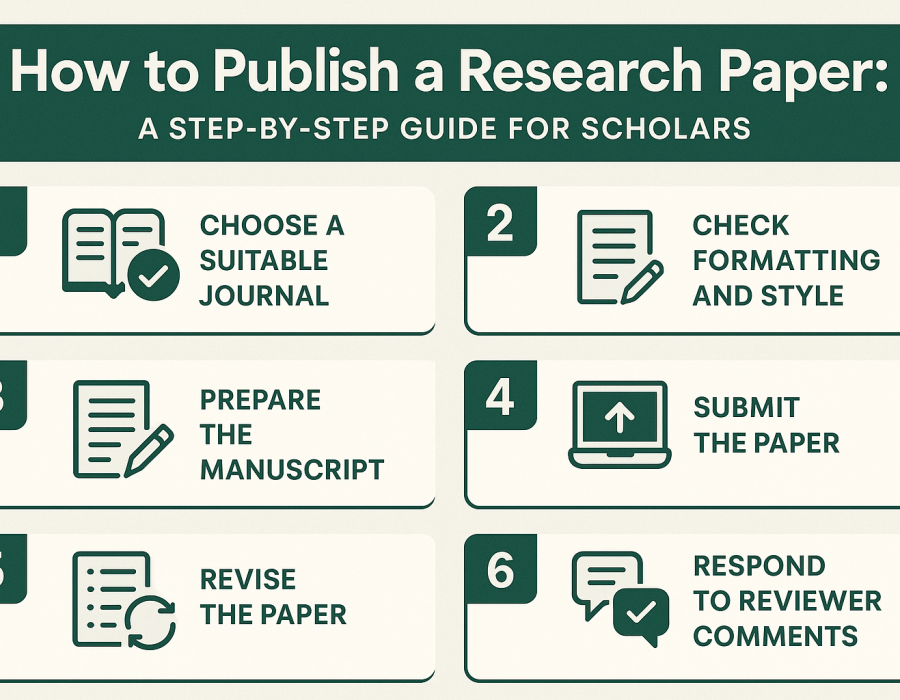
The process of publishing a research paper consists of a number of major steps: writing your paper, submitting your paper to a relevant journal, going through peer review, responding to revising, and finally gaining acceptance. Journals, conferences, and preprints are different and should be distinguished in terms of their purposes, audience and schedule.
Choosing the Right Journal for Submission
On selecting the right journal to submit. The following factors to consider include:
- Journal coverage: make certain that your subject matter fits the journal.
- Status of indexing: Find Scopus or SCI-indexed journals.
- Impact factor/quartile ranking: Check quality measures.
- Peer-review criteria: Ascertain the rigor of review.
- Submission rules: Formatting of review, word count and ethical considerations.
- Relevance to the audience: make sure that your findings are reaching the right audience.
Preparing a High-Quality Manuscript for Submission
Successful publication is based on a good manuscript. Key components include:
- Title: Clear and descriptive
- Abstract: Overview goals, procedures, findings, and conclusions.
- Introduction & Literature Review: Background information, state research gaps.
- Methodology: Describe study design and methods.
- Results & Discussion: Report on the findings and explain them.
- Conclusion/References: Summarize important findings and reference materials.
It is necessary to use clarity, originality, and strong evidence to make your manuscript outstanding.
Adhering to Submission Guidelines and Formatting Standards
Both journals have certain rules of guidelines for authors. It is important to follow them to prevent direct rejection. Focus on:
- Proper format and reference style.
- Limitations of words and figures/table norms.
- Ethical statements like authorship and conflict of interest.
Managing Peer Review and Revision Process
- Know how your methodology, clarity, and novelty are commonly reviewed.
- Be a professional in responding and cover every comment in detail.
- Rewrite your paper and post it again.
- Nominal Causes of Rejection (and Avoidance)
Common reasons for rejection are:
- Poor literature review or vague research questions.
- Incorrect methodology or inconsistency of data.
- Improper language, structure or scope discrepancy.
- Violation or unethical practices.
It is possible to avoid these traps through good preparation, editing, and following journal standards.
Post-Acceptance Steps: Proofreading, Editing, Proof Checks, and Publication Ethics
As soon as you are accepted, your work is not over. Other major activities after acceptance include:
- Final drafts copyediting and proofreading.
- Table formatting, figure, and reference formatting.
- Prequisite compliance with authorship, acknowledgements and disclosures.
- After copyright, Open access or license agreements.
How Professional Research Paper Writing Services Support Publication Success
To provide a more organized help to the scholars, the help of the experts can be organized.
Professional services may help in:
- Formatting, editing and writing of the manuscripts.
- Matching the content with journal requirements.
- Enhancing transparency and order.
- Improving the probabilities of acceptance.
Conclusion
The process of publishing a research paper is a systematic process and involves a lot of planning, paying appropriate attention and perseverance. Whether you are choosing the appropriate journal or writing a fined manuscript, responding to peer review, or setting up the post-acceptance procedure, each step makes you a successful scholar. Through them, researchers are assured of going through the research publication process successfully and in a more professional manner, contact from expert.
Comments